
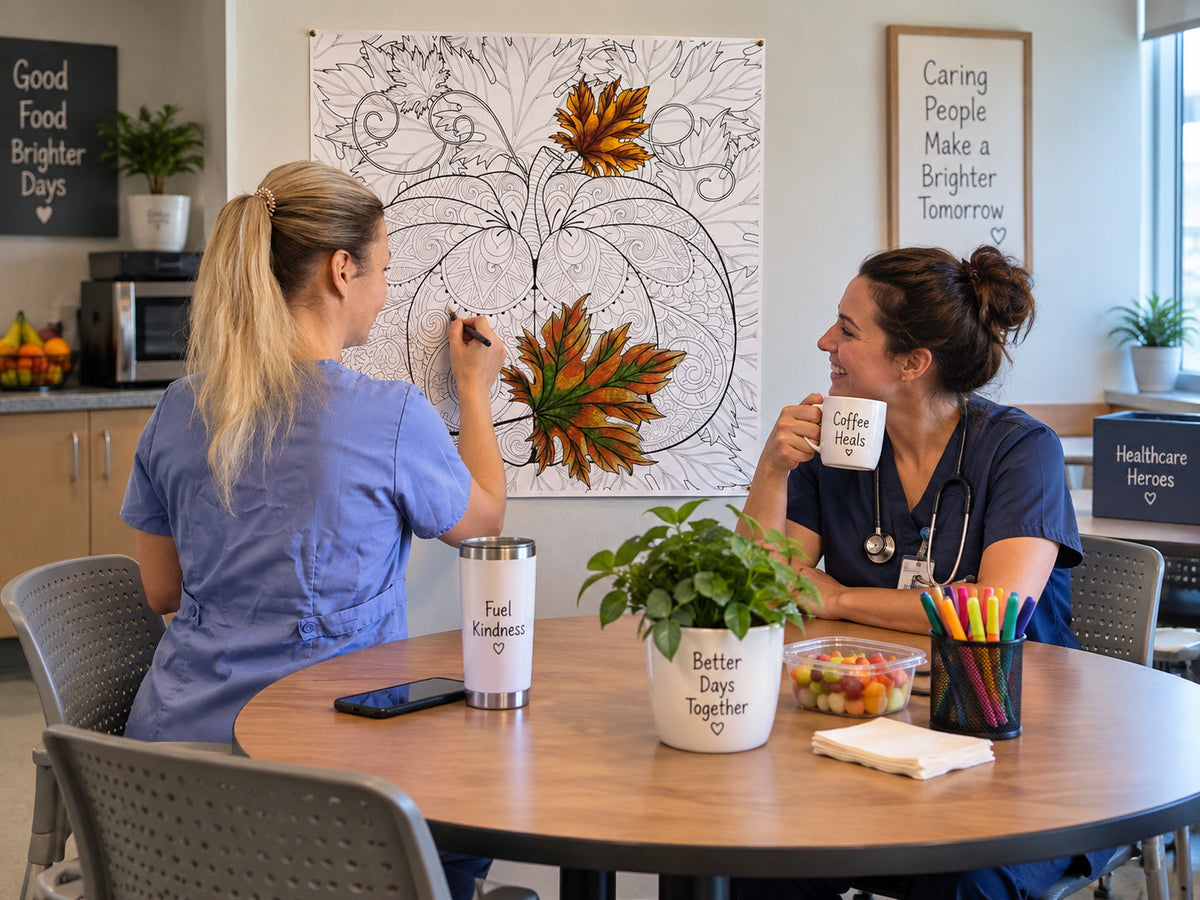
Day eleven of a hospital stay. The child has watched everything on the tablet, finished the puzzle twice, and colored every page in the individual coloring book the volunteer brought on day two. The activity cart comes around again with the same options. There's nothing wrong with any of it — but nothing is new, nothing takes more than twenty minutes, and nothing feels like it actually belongs to them in this room.
A giant coloring poster mounted on the wall across from the bed is a different kind of activity. It's too big to finish in one session. It's there every morning when they wake up and every evening when they can't sleep. It accumulates — each session adds something visible, and by day eleven it looks genuinely different than it did on day three. A child who has no control over most of what's happening in their life has full control over one corner of one wall. That corner is theirs.
Why Giant Coloring Posters Work Differently Than Individual Activity Books for Long Pediatric Stays
Individual coloring books work for short stays — an outpatient procedure, a two-day observation. Child life specialists and hospital volunteers have used them for decades because they're portable and easy. The problem shows up around day four or five. The book is finished, or the child has lost interest, or it's become associated with being sick because it was handed to them at admission. Long-stay patients need activities that last, grow, and don't feel like waiting.
A huge coloring poster scales to the length of the stay. There's always another section. On days when a child doesn't feel well enough to do much, coloring two small flowers is enough. On better days they might work on a detailed border for an hour. The poster doesn't reset. It holds all of it — and the visible progress is its own reward. A child who was too tired yesterday to color more than one petal can see that petal today and feel something about it.
The research backs this up. Studies on art therapy in pediatric settings consistently show that creative, hands-on activity reduces self-reported pain perception and anxiety in hospitalized children — independently of whether the child is receiving formal art therapy. The act of making something, and seeing it exist in the room, has a measurable calming effect. Child life specialists have documented this for decades. A large coloring poster on the wall is not a toy or a distraction in the dismissive sense — it's a therapeutic tool that doesn't require clinical administration.
5 Ways to Use a Giant Coloring Poster for Hospital Activities for Kids
1. The Long-Stay Patient Room
Mount the poster on the wall where the patient can see it from the bed — directly across, or on the side wall at a height reachable from sitting. This placement matters more than it sounds. A child who is too tired to ask for something to do will reach for a marker when one is within arm's length. The poster is always there. Sessions start when they feel like it and stop when they don't. No setup, no requiring the child to initiate anything, no one waiting for them to finish. The activity fits the energy of the day, not the other way around.
2. The Pediatric Infusion Center
Infusion treatments run for hours. Screens help, but screen fatigue sets in. A giant coloring poster mounted within reach of the infusion chair gives patients something tactile that they can do at their own pace without requiring both hands free and without needing to follow rules. Children undergoing chemotherapy infusions often have one arm occupied by an IV line — a large coloring poster at the right height is workable with one free hand in a way a small coloring book on a lap often isn't. Child life specialists also use visual focus — including coloring — as a distraction technique during blood draws, dressing changes, and other short procedures where the goal is to redirect attention. A poster on the wall of a procedure room isn't decoration. It's giving the child somewhere to look that isn't the needle.
3. The Pediatric Waiting Room
The waiting room population is siblings, parents, grandparents, and children waiting for appointments or results. Nobody wants to be there. A large coloring poster on the wall gives people something to do with their hands while their mind is somewhere else. A parent who has been up since 4 a.m. colors next to a three-year-old sibling who needs something to do. An older sibling who feels invisible in everything happening around them has something to contribute. The poster fills in over a day and looks different each afternoon than it did each morning. More than one parent has stood at a hospital waiting room coloring poster for longer than they expected and said afterward that it was the first fifteen minutes in days when they weren't thinking about what was happening down the hall.
4. The Ward Community Poster
One poster, in a common area or hallway, that every child on the unit adds to over the course of a month. When a patient is discharged, their section stays on the wall. When a new child arrives, they're invited to contribute to something that other kids who were in exactly their situation worked on. At the end of the month, the finished poster goes up permanently as the artwork of that ward's patients. A six-year-old who was admitted for three weeks can point to their specific section and tell their parents exactly which flowers they did. That matters to a kid. That's theirs on a wall in a building full of things that aren't.
5. Family Housing and Ronald McDonald House
Families staying in Ronald McDonald Houses, hospital family housing, or extended-stay facilities near treatment centers face the same long-stay challenge in a different setting. Parents who are with a child through weeks of treatment need low-key activities for evenings and the hours between appointments. A giant coloring poster in a common room runs itself — families from different rooms drift toward it, color for twenty minutes, go back. It creates brief, low-pressure connection between people all going through something hard. And parents coloring is not a small thing: the same cortisol-lowering mechanism that works for children works for adults. Caregiver burnout in pediatric oncology settings is documented and serious. An activity that quiets the mental noise for fifteen minutes, requires no decisions, and produces something visible is worth having available.
How to Set Up a Giant Coloring Poster in a Hospital Room

Featured above: Giant Coloring Poster - Butterflies 30x42
Hospital rooms have specific constraints that change how you hang and manage a poster.
Wall mounting: Painter's tape works on most hospital wall surfaces and comes off cleanly. For rooms where wall contact is restricted, a clipboard or foam-board backing can be clipped to an IV pole and adjusted to the patient's height. For bed-bound patients, center the poster at eye level when sitting up — not at standing height. The top third of the poster will go uncolored if it's out of reach.
Mounted on cardboard or foam board: Mounting the poster on stiff cardboard before hanging keeps it flat, rigid enough to be propped on a bed tray table if wall mounting isn't possible, and easy to move between rooms without damage. A foam-board-mounted poster also photographs better — parents document everything.
Infection control — the question every hospital coordinator will ask: Brush pens and colored pencils can be wiped down with standard hospital-grade disinfecting wipes. Assign each patient their own small cup of markers if shared supplies are a concern in your facility. Colored pencils are the simplest option for high-control infection environments — individual pencils, labeled by patient, no shared surfaces.
Supplies that work in a medical setting:
- Brush pens — smooth, no pressure required, zero fumes. The right choice for most hospital settings.
- Colored pencils — no smell, lowest stimulation, easiest to assign individually. Best for patients with sensory sensitivities or strict infection protocols.
- Glitter pens — for patients who want something more engaging; good for detail work during longer sessions.
Skip alcohol markers entirely in a medical setting. The solvent smell from cheap alcohol markers is detectable in enclosed spaces and can trigger nausea in chemotherapy patients, post-surgical patients with heightened scent sensitivity, and anyone whose nausea is being actively managed. This isn't a minor inconvenience — for a child on antiemetics, a smell that triggers nausea is a clinical event. Brush pens produce zero detectable smell and are the straightforward substitute at no meaningful cost difference.
Which Giant Coloring Poster Designs Work Best in Pediatric Settings
Nature and botanical designs — flowers, leaves, garden scenes — are the strongest choice across most pediatric settings. The open, organic shapes don't require precision and have no "wrong" way to color them, which matters for children in pain or with limited fine motor control. The complexity range within a single floral design covers both a six-year-old with the open petal sections and a twelve-year-old with the detailed leaf borders — without either child feeling mismatched to the activity.
Animal designs work particularly well for younger children and mixed-age pediatric wards. Large recognizable shapes give younger kids an immediate sense of accomplishment. The decorative detail around the animal gives older kids something to work on. A partially colored lion or elephant is visually compelling to anyone who walks by — which matters in a hallway or waiting room where you want people to stop and engage.
Mandala designs suit older pediatric patients and teen wards. The geometric structure is satisfying for patients who want focus and precision during long treatment sessions. Mandalas also photograph particularly well — important to teenagers who want something worth sharing from a period of their life they'd otherwise rather not document at all. A teen who posts a photo of a coloring poster they've been working on during chemo is asserting something about themselves: that they're still making things, still have a creative life, still exist beyond the hospital.
For infusion centers with a wide age range, a large floral coloring poster with a mix of open and detailed sections covers the broadest range of patients without requiring selection or sorting.
Ordering a Giant Coloring Poster for Your Hospital or Pediatric Unit
Hospital programs benefit from having multiple posters on hand. A patient who completes one during a long stay, or a ward that fills one in a month, shouldn't have to wait. The 3-poster bundle by SJPrinter — any three designs for $64.99 with free shipping — puts the cost at roughly $22 per poster and allows for design rotation across different spaces or over consecutive months. At that price point, a hospital gift shop, volunteer program, or child life department can keep a supply without a significant budget request.
All giant coloring posters by SJPrinter are 30"×42", printed to order on heavy paper stock in Cherry Hill, NJ. Overnight and 2-day shipping are available for facilities working to a specific program timeline. Free local pickup at 1400 Berlin Road, Cherry Hill, NJ 08003 for South Jersey hospitals and care facilities. Ships anywhere in the US, tax-free outside NJ.
Child life specialists and hospital volunteer coordinators who have used giant coloring posters in pediatric settings often use the same format in adjacent programs: after-school programs that serve medically complex children, public library reading programs, and senior and adult care settings — the same zero-prep, self-running logic applies wherever the goal is engagement without demanding energy people don't have.
Ordering for a Pediatric Unit or Hospital Program?
Giant coloring posters are printed by SJPrinter in Cherry Hill, NJ. Overnight and 2-day shipping available. Free local pickup for South Jersey facilities. Ships anywhere in the US, tax-free outside NJ.
856-429-0715 | info@sjprinter.com | 1400 Haddonfield-Berlin Rd, Cherry Hill, NJ 08003
Contact Us Request a QuoteGet new posts from SJPrinter
Practical print guides for South Jersey businesses. No spam.
Leave a comment
All comments are moderated before being published.
This site is protected by hCaptcha and the hCaptcha Privacy Policy and Terms of Service apply.