
Your visit plan
Time: late morning or early afternoon, before sundowning starts.
Group size: 2 to 3 people at once. Visit in shifts if more are coming.
Bring: a coloring poster already started, plus brush pens or glitter pens.
On arrival: introduce yourself warmly. Skip "Do you remember me?"
Leaving: keep it short, tie it to the activity, and don't linger.
Download the free Holiday Visit Kit (PDF, 8 pages, with a printable coloring page)
The holiday visits that go best are short, early in the day, and built around one shared activity instead of conversation. Call the staff first, bring a small group, give everyone something to do with their hands, and plan how you'll leave before you walk in. Each step is below.
Call the staff before you go
The staff see your parent every day, and you don't. A five-minute call answers the questions that decide how the visit goes:
- What time of day has been best for them lately?
- How are they handling the holiday decorations and the busier unit?
- Is there a quiet room or a table you can use?
- Are there rules about food, decorations, or how many visitors at once?
Ask one more thing: is there anything they've enjoyed doing this month. That answer is often better than any idea you'll find online.
What changes by stage
What works well in early-stage dementia can overwhelm someone in late stage. The opposite is true too: a quiet, slow-paced visit can feel too low-key for someone who can still hold a full conversation. See the Alzheimer's Association stage guide for the full symptom list.
| Stage | Best activity | How much to talk | What to avoid |
|---|---|---|---|
| Early | Color the poster together as equals. Let them pick colors and sections themselves. A detailed design holds their attention longer. | Normal conversation works well. People in this stage are still able to take part in meaningful conversation and social activities. | Treating them as less capable than they are. |
| Middle | A simpler, repeating task works best as the stage goes on. Adjust activities to the disease stage, and lean on repetitive tasks. | One-on-one, in a quiet space, with simple yes-or-no questions. | Correcting or arguing about colors, mistakes, or facts. |
| Late | Sit beside them and let them watch, or guide their hand for a few strokes. Watching still counts as taking part. | Mostly nonverbal: touch, tone of voice, and presence matter more than words. | Talking down to them, or over them, as if they aren't there. |
Visit length isn't something the Alzheimer's Association or NIA give a stage-by-stage number for. This is our own practical read, not a cited figure. Roughly 45 to 60 minutes often works in the early stage, 20 to 30 minutes in the middle stage, and 15 to 20 minutes in the late stage. Watch for tiredness throughout.
Pick the right time and keep the group small
Many people with dementia get more confused and restless later in the day. So aim for late morning or early afternoon. A full family at once can be a lot. Two or three people is easier for your parent to follow, and you can visit in shifts.
If kids are coming, prepare them in the car. Tell them Grandma might not remember their name, and that's okay. Then give them a job. Kids who have something to do worry less about what to say.
Bring an activity, not a conversation plan
Conversation leans on memory. Questions like "Do you remember last Christmas?" can put your parent on the spot. Doing something side by side takes that pressure away. You can talk while you work, or not talk at all.
Each common holiday activity has trade-offs:
| Activity | Works well when | Watch out for |
|---|---|---|
| Photo album | They enjoy reminiscing | Faces they don't recognize can upset them |
| Old holiday music | Music still gets a reaction | Shared rooms and volume |
| Crafts with small pieces | Hands are steady | Small parts frustrate stiff fingers |
| Giant coloring poster | You want everyone to join in | Needs a table and the right markers |
The National Institute on Aging suggests choosing activities everyone can enjoy and letting the person simply watch if they prefer. Watching counts. Sitting with family while the poster fills in is still being part of the holiday.
What to say when...
"I want to go home" (and they're already home). Don't correct them. For a person with dementia, home is often a feeling, not a place. It can mean a memory of feeling safe and comfortable. Try "Tell me about your favorite room at home" instead of "You are home."
They ask for someone who has died. Ask what they need from that person right now, instead of restating the loss. Try "Is there a reason you need them?" or "Do you miss your mom?" Then bring in a photo or a memory.
They don't recognize you. Stay calm, give a brief explanation, and show a photo if you have one. Offer corrections gently: "I think she's your granddaughter Julie," not "You don't remember your own granddaughter?"
They get upset when you leave. A quick, consistent goodbye works better than a long one. Lingering or apologizing tends to make the next goodbye harder, not easier.
How to set up a coloring poster in a care room
Tape the corners to the table so it doesn't slide. Sit next to your parent, not across. Before you arrive, color one small section yourself so the page doesn't look blank. A blank page can feel like a test.
Use brush pens or glitter pens. They're easier to grip and they glide on our paper. Skip cheap alcohol markers, which bleed through.

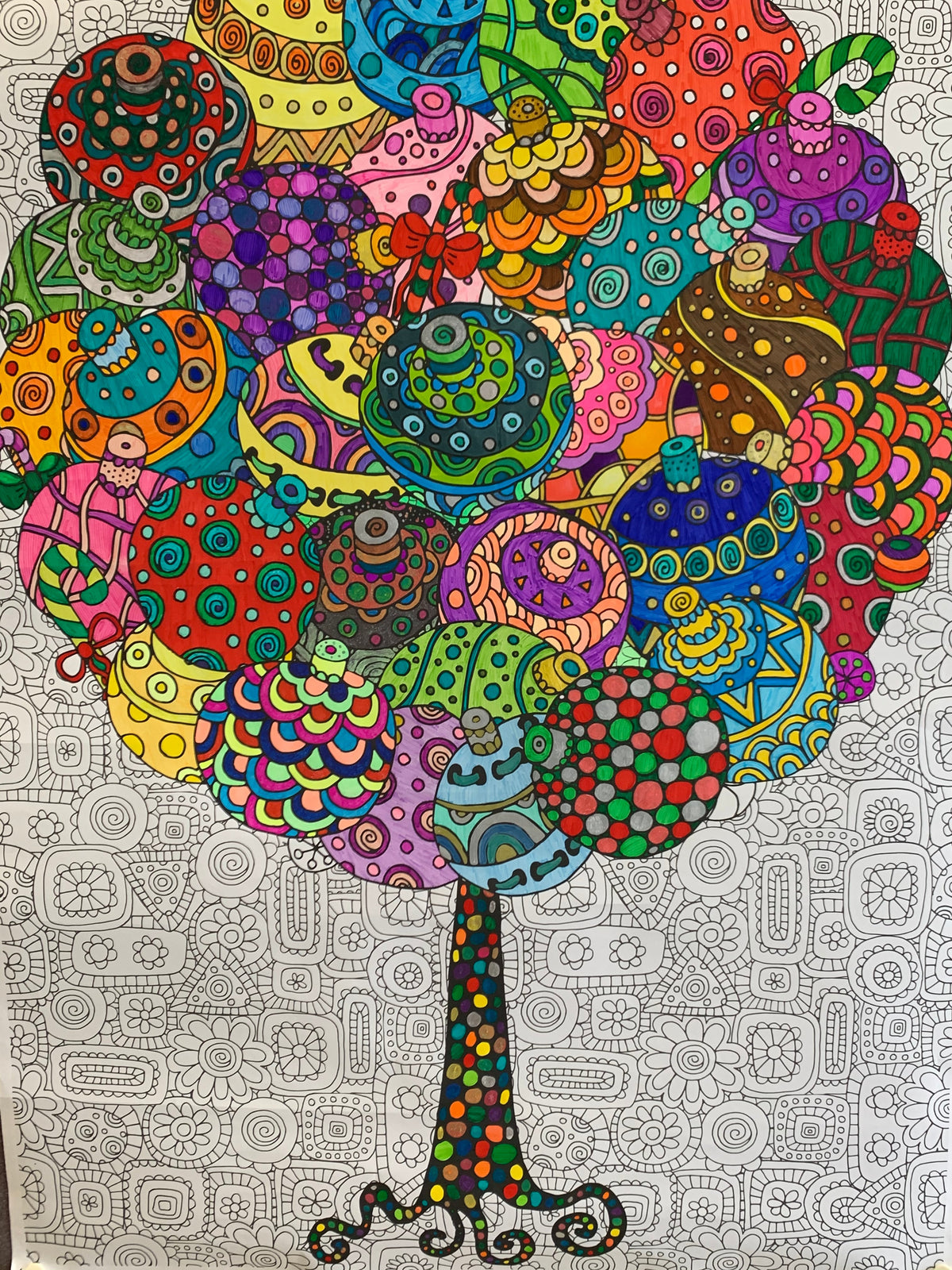
Which design to pick. Design choice comes down to what your parent has always liked, the same as it would for anyone. Someone who's always loved flowers will reach for a floral design. Someone who loves animals will reach for the Brave Lion. During the holidays, people tend to gravitate toward the seasonal ones, like Christmas Tree or Holiday Trees. There's no single "right" design for dementia. Pick the subject, not the diagnosis.
Which marker to bring. Grip and smoothness vary by manufacturer and barrel construction, not by marker type. A brush pen from one brand can glide easily while a brush pen from another feels scratchy, and the same is true for thin markers. Bring two or three different options if you can and let your parent try them, rather than assuming one category works best.
Pick the size for the space:
- Christmas Tree, 30×42: for a table in their room or a small activity area.
- Holiday Trees, 30×52: for a common room, where staff might hang the finished poster afterward.
One customer bought a poster for her 82-year-old mother, who has the beginnings of dementia: "We worked on it together, and when the grandchildren came over, they also worked on it." (Amazon review)
Shop the Christmas Tree poster, 30×42
Holiday decorations, crowds and gifts
Decorations. Skip candy, artificial fruit, and other decorations that could be mistaken for real food, and go easy on blinking lights. Both can genuinely confuse, not just distract.
Crowds. The same rule as the visit itself applies: smaller is easier to follow. A change in routine can be confusing, and a full house is a bigger routine change than a quiet one.
Gifts that work together:
- A coloring poster you work on side by side.
- A photo album or simple puzzle you can do as a pair.
Gifts that work alone, for lower-key moments:
- Soft blankets, slippers, or a weighted lap pad.
- Favorite music on a simple one-button player.
Avoid tools, complicated electronics, challenging games, or anything with small parts or a learning curve. Frustration isn't the gift anyone's going for.
When it's time to leave
Families tell us leaving is often the hardest part. A few things help. Keep the goodbye short. Tie it to the activity: "We'll finish this tree next time." Leave the poster in the room, so there's something from the visit still there after you go. If leaving usually upsets your parent, ask a staff member to start a new activity with them as you step out.
If you can't visit in person
Mail a poster to the activity team. Call ahead and ask if they'd use it in a group session. Staff can start it with residents, and you can see the progress on your next visit or ask for a photo.
Browse our full range of giant coloring posters for other designs and sizes. If this becomes a regular part of your visits and not just a holiday activity, our guide to coloring activities for seniors with dementia covers the year-round version. We also have a general guide to visiting elderly parents if the holiday timing doesn't apply to you.
Key takeaways
- Call the facility before you go. Staff know what's working this month better than any article does.
- Match the activity and the visit length to the stage, not a generic holiday checklist.
- Bring a shared task, not a conversation plan. Coloring works because it needs no memory to join in.
- A quick, calm goodbye beats a long one, every time.
Questions people ask
Should I bring my parent home for Thanksgiving? It depends on the stage of dementia. A change in routine can be confusing, and a crowded house even more so, so ask the staff how they've handled outings lately.
What if they don't recognize me? Introduce yourself simply and warmly. Don't correct them or ask them to remember. Join them where they are.
How long should a holiday visit be? Shorter often goes better. Watch for tiredness and leave while the mood is still good.
What's a good holiday gift for someone in memory care? Something to do or to look at. Things that need setup or many steps tend to go unused.
Will a poster arrive before the holidays? We print and ship within 24 hours. Delivery takes 3 to 7 days. Order by December 12 for Christmas.

Leave a comment
All comments are moderated before being published.
This site is protected by hCaptcha and the hCaptcha Privacy Policy and Terms of Service apply.